Despite a lost lawsuit, plaintiff hopes for a freer society for all faiths as personal cost of publicly exposing religious beliefs is highlighted
 Logo of the Sekai Nippo
Tokyo, 10th October 2026 – Published as an article in the Japanese newspaper Sekai Nippo. Republished with permission. Translated from Japanese. Original article.
“There Is Value in Having Fought to the End”
Plaintiff and Lawyers Report on Lawsuit Against Eito Suzuki Over Disclosure of Religious Faith
by the editorial department of Sekai Nippo
The Tokyo District Court on 8th October dismissed the claims of a male member of the Family Federation for World Peace and Unification (FFWPU, formerly the Unification Church), who had sued journalist Eito Suzuki (鈴木エイト) for invasion of privacy and defamation.
See also New Survey: Widespread Distress Among Believers
Following the ruling, the plaintiff and his attorneys held a press briefing in Tokyo. The following is a summary of their remarks.
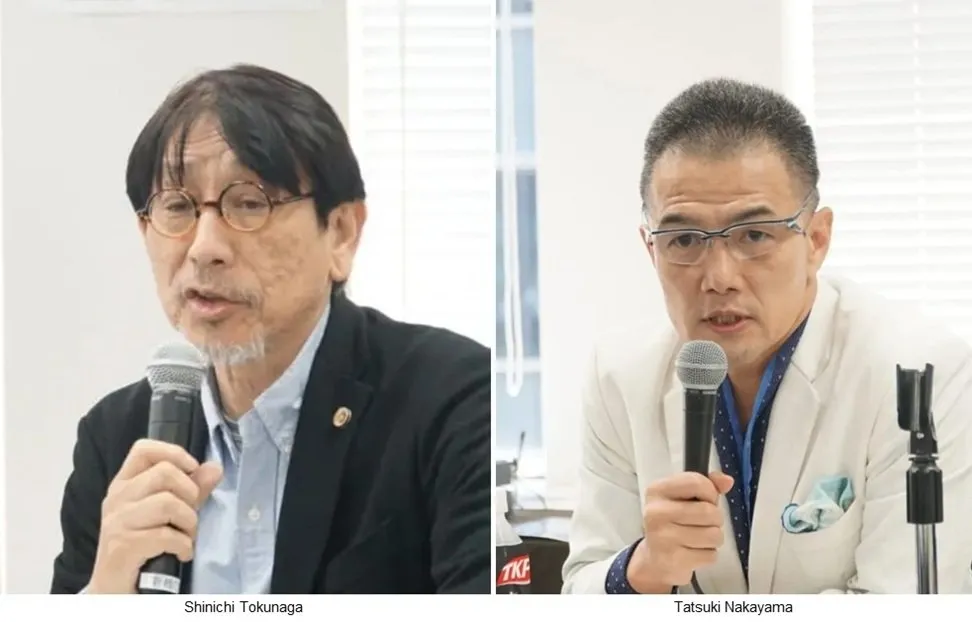
Attorney Tatsuki Nakayama: “A Disappointing Judgment That Fails to Recognize Damage to the Plaintiff’s Social Standing”
In cases involving privacy such as this one, the court must make an overall assessment by weighing the plaintiff’s right to privacy against the defendant’s freedom of expression and the public interest served by the disclosure. In legal terminology, this is known as a “balancing of competing interests”. There were several weaknesses in our case.
First, before the shooting incident involving former Prime Minister Shinzo Abe (安倍晋三), the plaintiff had listed his real name and his employment as a religious organization staff member on his LinkedIn profile, intending to connect with other religious professionals. (This information has since been deleted.)
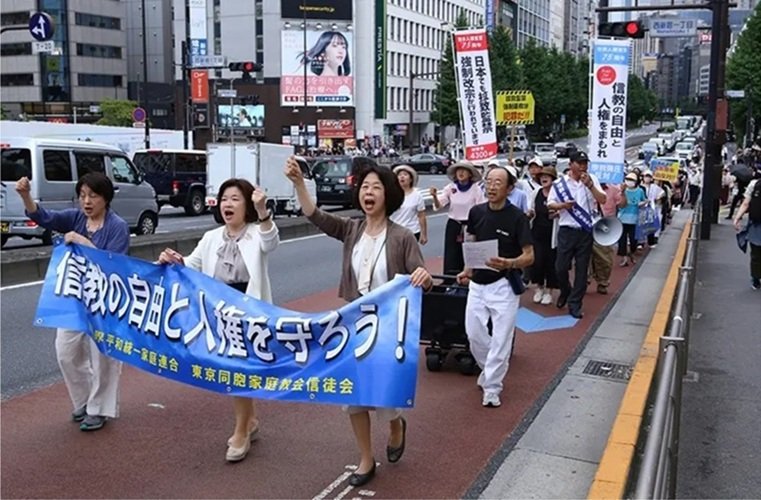
 From a demonstration 29th May 2016 in Shibuya, Tokyo held by UNITE, a student organization primarily of Family Federation second-generation believers in Japan. Photo UNITE
He had also posted photographs of himself and his family on a blog, identifying himself anonymously as “an administrative staff member of the Unification Church”. Furthermore, when he participated in a street speech organized by UNITE, an organization of second-generation believers, in June 2016, he introduced himself by name to Suzuki, who approached him. In December 2023, although he did not disclose his name, he appeared in public and delivered a street speech as a member of the International Federation for Victory over Communism.
Based on these circumstances, the court concluded that the plaintiff had been prepared, to some extent, for his religious affiliation to become public knowledge. It therefore ruled that Suzuki’s actions did not constitute a tort.
Suzuki had described the plaintiff as someone involved in a disguised volunteer organization. In addition to alleging an invasion of privacy, we added a defamation claim partway through the proceedings. However, I was surprised that the judgment concluded that merely stating that the plaintiff was affiliated with a particular religious organization, and that he had not disclosed the nature of that relationship, did not diminish his social standing.
The circumstances in which these statements were made were crucial. At the time, the Family Federation was facing its most intense public criticism following the assassination of former Prime Minister Abe. It was in this climate that the plaintiff’s connection to the Unification Church was exposed. We brought the case on the grounds that disclosing this information under such circumstances constituted an invasion of privacy and defamation. It is disappointing that the court nevertheless concluded that there was no evidence that his social standing had been diminished.
Suzuki uploaded several photographs of the plaintiff. The judgment stated that the plaintiff had not refused to be photographed. However, during the two years of litigation, whether the plaintiff had actually consented to being photographed was never a point of contention. Many of the photographs were taken at an angle. If they had been taken covertly, the plaintiff might not even have realized that he was being photographed, let alone consented to it.
Attorney Shinichi Tokunaga: “Human Rights Are Won by Those Who Fight for Them”
This case concerned how to draw the line between the right to privacy and freedom of expression when the two come into conflict.
It is true that the plaintiff had disclosed some private information on social media, but this was before the incident involving former Prime Minister Abe. At that time, the social climate surrounding the Unification Church had not yet created the circumstances in which people would feel compelled to be extremely cautious and conceal their religious affiliation. These earlier disclosures should not be regarded as an abandonment of his right to privacy.
 Militantly campaigning against the Family Federation: Activist journalist Eito Suzuki, born as Kiyofumi Tanaka. Photo: Mikkabie / Wikimedia Commons. License: CC ASA 4.0 Int. Cropped
Regarding the plaintiff’s volunteer activities, Suzuki disseminated information in a manner that portrayed them as if they were somehow sinister. This arguably went beyond the scope of what should be protected as freedom of expression. Nevertheless, the court ultimately prioritized the public interest cited by Suzuki and ruled that his actions did not constitute a tort.
As for the defense’s reliance on freedom of expression, there is no doubt that public interest in the Family Federation increased significantly after Abe’s assassination. That interest was stimulated by rumors, including misinformation, and by mass-media coverage. The Japanese Communist Party and others were also conducting campaigns claiming that the Family Federation was responsible for corrupting Japanese politics. Investigating such matters and disclosing relevant facts can, in principle, serve the public interest.
One reason it is difficult for plaintiffs to win lawsuits involving the Family Federation is that, in the prevailing social climate, disclosing someone’s affiliation with the organization tends to be regarded almost automatically as serving the public interest.
Nevertheless, regardless of the outcome of this case, it remains necessary for people to speak out and challenge what they believe to be unacceptable, guided by their own conscience.
At least for the time being, however, believers engaging in social activities may have little choice but to act with the determination to assert publicly that they have the same rights as anyone else.
To fight openly, believers are placed in the difficult position of having to take the risk that their religious affiliation will be exposed. But human rights are won by those who fight for them. We cannot expect society to show consideration simply because we do nothing.
In its ruling on the dissolution order against the Family Federation, the Tokyo High Court stated that there was no alternative to depriving the religious organization of its legal corporate status. At the same time, it indicated that human rights violations, including the deprivation of believers’ freedom of religion, must not be tolerated.
Although these statements by the Tokyo High Court may appear contradictory at first glance, they can also be interpreted as acknowledging that the faith of Family Federation members is genuine, rather than some kind of sham or fraud. That is something we should remember.
The Plaintiff: “I Could Not Bear to See My Children Suffer”
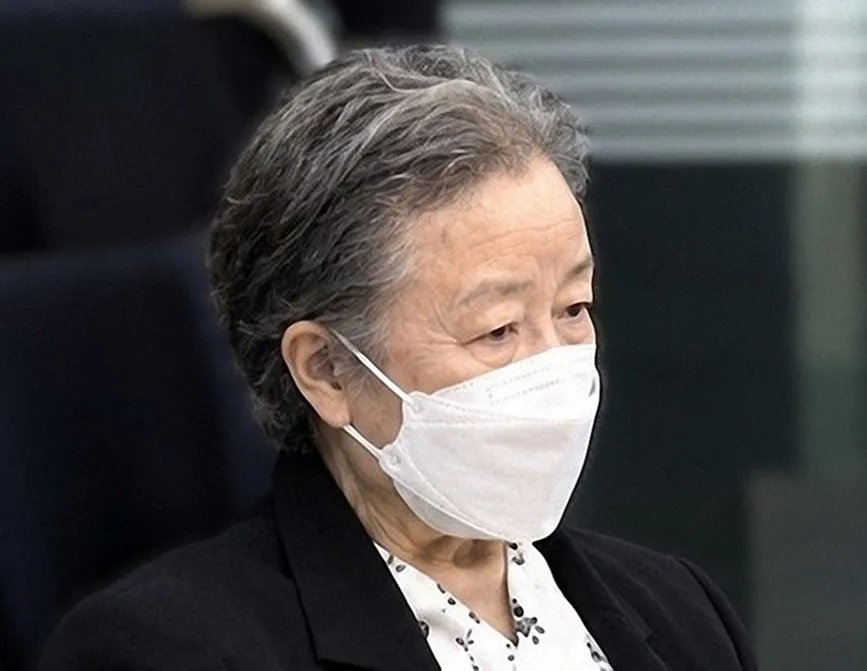
 Plaintiff A, a Family Federation member who sued Eito Suzuki for violating his privacy, in Tokyo, September 2024. Photo: Sekai Nippo
When I was involved in volunteer activities, I once received an email from a parent after local children had participated in a neighborhood litter-picking activity. The parent wrote:
“My children have started picking up rubbish they see on the streets. Thank you so much.”
That experience reinforced my belief that my activities were not in vain and that they served a meaningful purpose. I was never concealing my identity through what has been called “disguised volunteering”. I participated because I wanted to contribute to and show love for my community, and because I wanted to provide a good example and a positive education for my own children.
Then everything changed. An impression was created that holding a particular religious faith was itself something evil. For a time, even my children found themselves unable to appear in public.
I could accept being blamed myself, but watching my children and the people I had worked with in volunteer activities suffer was unbearable and deeply painful. I even wondered whether it would have been better never to have participated in volunteer work at all.
But if things remain as they are, will future second- and third-generation members of the Family Federation come to believe that they should simply keep quiet and avoid speaking out? I do not want a world in which people are made to feel miserable or ashamed of their religious faith.
That is why I believe there was value in fighting this case through to the end, regardless of the judgment.
I hope Japan will become a freer country for people of every faith. Even while the Family Federation is being treated as an “antisocial force”, I want to continue fighting.
I hope this lawsuit will serve as a signal to those who feel constrained and marginalized because of their religious beliefs – a starting point for building a society in which they can openly express their faith and share their joy without fear.
See also New Survey: Widespread Distress Among Believers
Featured image above: Attorneys Shinichi Tokunaga and Tatsuki Nakayama at press conference in Tokyo on 8th October 2026. Photo: Sekai Nippo
Related to lost lawsuit about invasion of privacy: Lawfare: State Uses Legal System in War on Faith
More, related to lost lawsuit about invasion of privacy: Scholar Questions Secrecy in Dissolution Case
And more, related to lost lawsuit about invasion of privacy: Shocked Author: “Japan Ignores Basics of Justice”
Still more, related to lost lawsuit about invasion of privacy: Legal Inconsistencies A Blow to Democracy
Even more, related to lost lawsuit about invasion of privacy: Court Accused of Using Speculation
Also related to lost lawsuit about invasion of privacy: MEXT’s Legal Spin and “Dissolution at All Costs”
Also related to lost lawsuit about invasion of privacy: UN Report: Japan’s Lawfare Against Faith Minority
And also related to lost lawsuit about invasion of privacy: Protesting No Transparency in Closed-Door Trial
More, related to lost lawsuit about invasion of privacy: Dangerous Flaws in Dissolution Order Decried
Also related to lost lawsuit about invasion of privacy: “Lawyers Lying and Shaming Japan” for 50 Years
And also related to lost lawsuit about invasion of privacy: Japan Following the Way of China
And also related to lost lawsuit about invasion of privacy: Japan’s Dissolution Case Echoes China’s Playbook
More, related to lost lawsuit about invasion of privacy: Media/Legal Expert: Communism Behind Persecution
And more, related to lost lawsuit about invasion of privacy: Militant Lawyers Dictate Government Policy
More, related to lost lawsuit about invasion of privacy: Collusion to Rob Minority of Its Rights
And more, related to lost lawsuit about invasion of privacy: State and Media Creating “Today’s Non-Citizens”
Still more, related to lost lawsuit about invasion of privacy: Japan Copying China: State Seizure of Churches
And still more, related to lost lawsuit about invasion of privacy: 12 Religious Freedom NGOs Denouncing Japan
More, related to lost lawsuit about invasion of privacy: 4300 Abductions and Forcible Detentions
And more, related to lost lawsuit about invasion of privacy: Japan: Families Fear for Graves of Loved Ones
Yet more, related to lost lawsuit about invasion of privacy: Lawyers Manipulating, Coercing, Lying
Also related to lost lawsuit about invasion of privacy: Kishida Follows Anti-Family Federation Minister
Also related to lost lawsuit about invasion of privacy: Militant Lawyers Dictate Government Policy
Still more, related to lost lawsuit about invasion of privacy: Malicious One-Sided Government Source Selection
And still more, related to lost lawsuit about invasion of privacy: Japan Urged to Make U-Turn
And yet more, related to lost lawsuit about invasion of privacy: Dangerous Precedent to Crush Religions
Even more, related to lost lawsuit about invasion of privacy: Japan Following the Way of China
Yet more, related to lost lawsuit about invasion of privacy: Japanese Communists’ Final War
Still more, related to lost lawsuit about invasion of privacy: Political and Social Activism behind Oppression
Still more, related to lost lawsuit about invasion of privacy: Dissolution Case: Rule of Law on Trial 4th March