
Main attorney for persecuted religious minority accuses recent Tokyo High Court ruling of violating evidence-based adjudication, using speculation to justify dissolution order
 Logo of the Sekai Nippo
Tokyo, 13th March 2026 – Published as an article in the Japanese newspaper Sekai Nippo. Republished with permission. Translated from Japanese. Original article.
Determining unlawfulness through inference disregards human rights
“Contrary to the Principle of Evidence-Based Trials,” Says Family Federation Attorney
by editorial staff of Sekai Nippo
 The building housing Tokyo High Court and Tokyo District Court. Photo (2012): Rs1421 / Wikimedia Commons. License: CC ASA 3.0 Unp
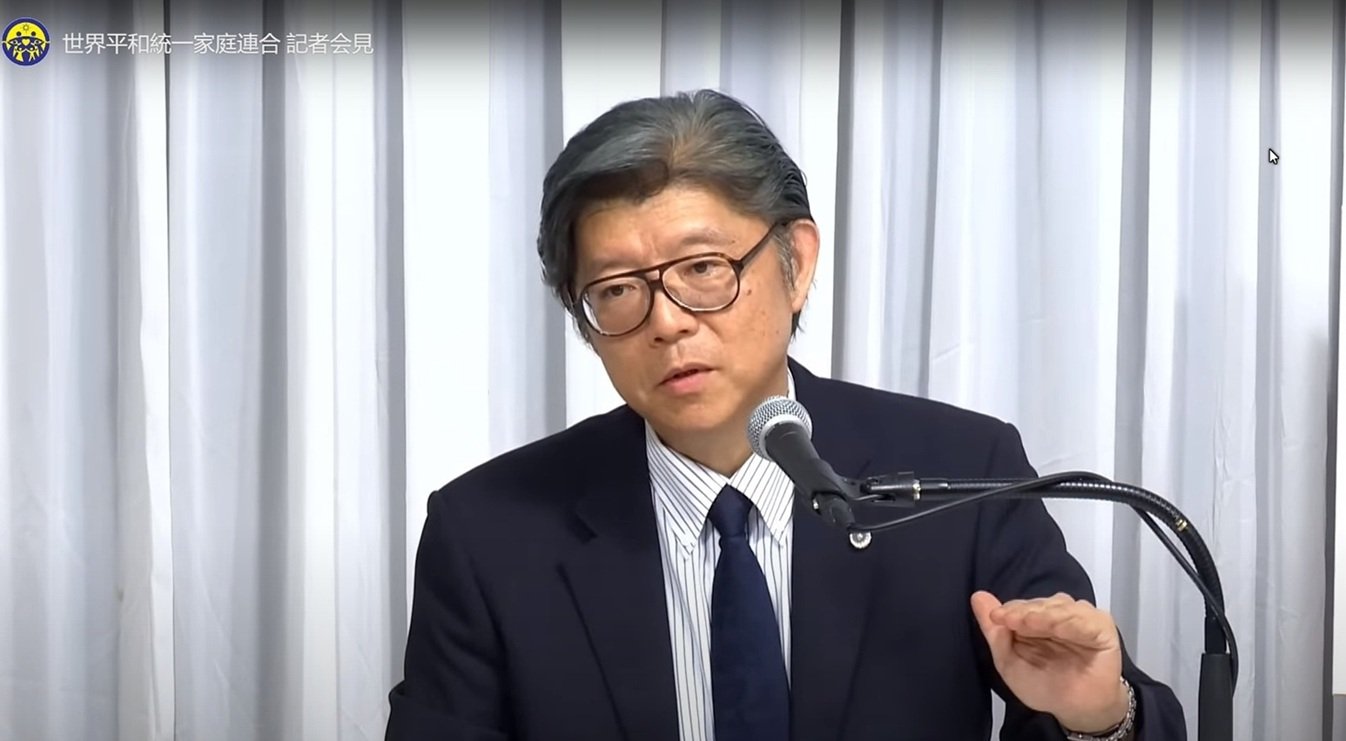
Following the decision on 4th March by the Tokyo High Court to dismiss the appeal in the case concerning the dissolution order against the Family Federation for World Peace and Unification (formerly known as the Unification Church), attorney Nobuya Fukumoto (福本修也), representing the appellants, released his opinion on 12th March on his law firm’s website and other platforms.
See also State Grabs 260 Churches After Dissolution
See also UN Submission Protests Mass Closure of Churches
See also Scholar Questions Secrecy in Dissolution Case
See also Legal Inconsistencies A Blow to Democracy
See also “Loss of Appeal Part of Systemic Persecution”
See also Social Ostracism for Believers After Legal Loss
See also Final Legal Avenue: Special Appeal Filed
Fukumoto strongly criticized the ruling, stating that it “disregards the freedom of religion and human rights of more than 100,000 believers and has effectively handed down a death sentence to a religious corporation based on ‘delusions’ not grounded in fact.”
Fukumoto argued that the High Court’s decision essentially followed the ruling issued by the Tokyo District Court in March last year. He said the ruling recognized tort liability based solely on abstract speculation without identifying specific unlawful acts, and therefore “further deepened and expanded the serious defect of violating the principle of evidence-based adjudication.”
In October 2023, the Ministry of Education, Culture, Sports, Science and Technology petitioned the Tokyo District Court to dissolve the organization. The ministry cited 32 civil judgments recognizing tort liability as well as settlement cases, claiming that donation-related damages totaled about ¥20.4 billion (around 1,550 victims).
The Tokyo District Court determined that more than 1,500 people suffered damages totaling approximately ¥19.4 billion between around 1980 and 2009.
 Pie charts showing the categories of alleged damages after the Family Federation’s 2009 compliance declaration (left) [See editor’s note 1 below] and the determination of tort liability. Original illustration: Attorney Tatsuki Nakayama, English version aided by ChatGPT.
 Attorney Tatsuki Nakayama, here in December 2023. Photo: Sekai Nippo
Furthermore, according to international lawyer Tatsuki Nakayama (中山達樹), since the religious organization issued its “Compliance Declaration” [See editor’s note 1 below] in 2009, out of 144 individuals alleged to have suffered damages in relation to large donations and similar matters, tort liability has been recognized for only four people (one through settlement), or 2.8%.
In monetary terms, about ¥18.6 million out of approximately ¥957 million in alleged damages – 1.95% – was found to involve tort liability. Settlements were reached with 132 individuals. Nakayama stated that it is clear that damages have drastically decreased since the compliance declaration [See editor’s note 1 below].
The High Court decision itself acknowledged that “it cannot be definitively determined” that unlawful acts occurred due to lack of facts and evidence, while simultaneously stating that “the possibility cannot be denied.”
Fukumoto criticized this reasoning as internally contradictory, saying:
“The court piles inference upon inference until it somehow arrives at a definitive recognition of unlawful acts, and then uses that conclusion to emphasize the necessity of a dissolution order. Such reasoning completely departs from the fundamental structure of judicial proceedings in a rule-of-law state.”
 Imbalanced scale of justice and use of speculation in dissolution case behind closed doors. Photo: 991joseph / Wikimedia Commons. Public domain image
Nakayama also pointed out that it is difficult to claim that there were acts clearly recognized as “seriously harming the public welfare”.
As for the background behind what he called “the adoption of unjust logic”, Fukumoto suggested two factors:
- The courts were influenced by a strong social climate (public opinion) demanding that the Unification Church be destroyed, leading to a conclusion-driven judgment.
- Because the proceedings were conducted as closed-door non-contentious proceedings [See editor’s note 2 below], the court was able to push through reasoning that would never be accepted in ordinary civil litigation.
On 9th March, the organization filed a special appeal to the Supreme Court.
It plans to challenge the ruling on the grounds that the High Court decision contains serious legal problems, including violations of the Constitution and international law.
See also State Grabs 260 Churches After Dissolution
See also Shocked Author: “Japan Ignores Basics of Justice”
See also Japan: “Death Penalty” Without Proof of Illegality
See also Experts Question Legal Basis for Dissolution
See also UN Submission Protests Mass Closure of Churches
See also Scholar Questions Secrecy in Dissolution Case
See also Legal Inconsistencies A Blow to Democracy
See also Protesters Sound Alarm on Japan’s Faith Policy
See also “Loss of Appeal Part of Systemic Persecution”
See also Social Ostracism for Believers After Legal Loss
See also Final Legal Avenue: Special Appeal Filed
Featured image above: Attorney Nobuya Fukumoto, here speaking at a press conference in Tokyo 8th September 2023. Screenshot from live transmission by FFWPU
[Editor’s note 1: The 2009 compliance declaration of the Unification Church of Japan (now the Family Federation for World Peace and Unification) was a formal commitment by the organization to reform its practices in response to longstanding public criticism and legal challenges.
The Unification Church in Japan had faced numerous allegations related to recruitment tactics and donation solicitation, termed “spiritual sales” (霊感商法) by a hostile network of activist lawyers who had declared the religious organization an enemy. These issues led to multiple lawsuits orchestrated by the activist lawyers and significant media backlash. This prompted the organization to take measures to restore its reputation and demonstrate compliance with legal and ethical standards.
The religious organization pledged to stop possibly unethical donation practices, including what the hostile network of lawyers claimed amounted to “pressuring members into making large financial contributions under spiritual pretexts.”
This was in response to accusations from the same activist lawyers that followers “were being manipulated into giving away substantial amounts of money or property.”
The Unification Church stated it would enhance internal oversight to ensure compliance with ethical and legal standards. Measures included better training for leaders and stricter guidelines for evangelization and solicitation of donations.
After this compliance declaration, there was a significant decrease in the number of lawsuits against the Unification Church – since 2015 called the Family Federation. The religious organization has used this as evidence that it has improved its practices and should not be subject to dissolution.]
[Editor’s note 2: A non-contentious case refers to a legal matter where there is no dispute between parties. These cases typically involve administrative, procedural, or uncontested legal actions, such as probate (handling a deceased person’s estate), uncontested divorces, adoption, or registering a trademark. Since there are no opposing parties or legal conflicts, these cases usually proceed smoothly through the legal system without litigation.]
Related to court accused of speculation: Lawfare: State Uses Legal System in War on Faith
Also related to court accused of speculation: MEXT’s Legal Spin and “Dissolution at All Costs”
Also related to court accused of speculation: UN Report: Japan’s Lawfare Against Faith Minority
And also related to court accused of speculation: Protesting No Transparency in Closed-Door Trial
More, related to court accused of speculation: Dangerous Flaws in Dissolution Order Decried
Also related to court accused of speculation: “Lawyers Lying and Shaming Japan” for 50 Years
And also related to court accused of speculation: Japan Following the Way of China
And also related to court accused of speculation: Japan’s Dissolution Case Echoes China’s Playbook
More, related to court accused of speculation: Media/Legal Expert: Communism Behind Persecution
And more, related to court accused of speculation: Militant Lawyers Dictate Government Policy
More, related to court accused of speculation: Collusion to Rob Minority of Its Rights
And more, related to court accused of speculation: State and Media Creating “Today’s Non-Citizens”
Still more, related to court accused of speculation: Japan Copying China: State Seizure of Churches
And still more, related to court accused of speculation: 12 Religious Freedom NGOs Denouncing Japan
More, related to court accused of speculation: 4300 Abductions and Forcible Detentions
And more, related to court accused of speculation: Japan: Families Fear for Graves of Loved Ones
Yet more, related to court accused of speculation: Lawyers Manipulating, Coercing, Lying
Also related to court accused of speculation: Kishida Follows Anti-Family Federation Minister
Also related to court accused of speculation: Militant Lawyers Dictate Government Policy
Still more, related to court accused of speculation: Malicious One-Sided Government Source Selection
And still more, related to court accused of speculation: Japan Urged to Make U-Turn
And yet more, related to court accused of speculation: Dangerous Precedent to Crush Religions
Even more, related to court accused of speculation: Japan Following the Way of China
Yet more, related to court accused of speculation: Japanese Communists’ Final War
Still more, related to court accused of speculation: Political and Social Activism behind Oppression
Still more, related to court accused of speculation: Dissolution Case: Rule of Law on Trial 4th March


