

State failure to fulfil its political responsibility creates vacuum leaving long-term peacebuilding to others through backdoor politics
 The logo of the Segye Ilbo
On 31st December 2025, the Korean daily Segye Ilbo issued an opinion piece which in English would be headlined “The Unification Church’s Peace Project ‒ Wasn’t This the State’s Job?” It was written by Moon Yong-dae (문용대), a Korean essayist, literary award recipient, and opinion columnist.
See also Religion Between Engagement and Withdrawal
See also Devotion of Japanese Wives in Korea Awarded
See also Climate of Suspicion: Peace Reframed as Politics
See also Korea: Can Religion and Politics Be Disentangled?
See also Some Religions Are Welcome in Politics, Some Not
See also Faiths Caught in Expanding Political Crackdown
See also Peace Ambassador Program Is Civic, Not Political
 Separation of religion and state. Illustration: CoPilot Ai, 1st January 2026
In many Western democracies, the separation of religion and state is treated as a foundational rule of political life. Religious groups are expected to stay out of policymaking, and governments are expected to remain neutral toward belief systems. This principle exists to protect individual freedom, prevent coercion, and maintain pluralism in diverse societies. From this perspective, any large political or geopolitical project associated with a religious organization is often viewed with immediate suspicion.
The Segye Ilbo opinion piece starts from this widely shared assumption but argues that it is not sufficient, on its own, to explain how ambitious international peace projects actually emerge ‒ or why religious and civil society actors sometimes play outsized roles in proposing them. The article uses the long-debated Korea-Japan undersea tunnel as a case study to explore this tension.
 An illustration of an undersea tunnel between South Korea and Japan. Image: CoPilot Ai, 1st January 2026.
The proposed tunnel, which would physically connect Japan and the Korean Peninsula, has been controversial for decades. One reason is its enormous technical and financial cost. Another, more politically sensitive reason is its association with the Family Federation for World Peace and Unification ‒ also often called by its former name, the Unification Church. In South Korea and Japan alike, the movement is often portrayed by media as politically active, highly organized, and controversial. As a result, critics have dismissed the tunnel proposal as an attempt by a religious organization to expand its influence under the guise of infrastructure or peacebuilding.
The article does not deny these concerns, but it asks readers to step back and examine the broader context. From the Family Federation’s own perspective, the tunnel is not merely a transportation project. It is imagined as a symbolic and practical link between island Japan and continental Asia, between maritime and land-based civilizations. More importantly, it is framed as one component of a much larger peace vision that includes international highway networks (“Peace Road”), cross-border peace parks between North and South Korea, and even the idea of hosting a future United Nations office on the Korean Peninsula.
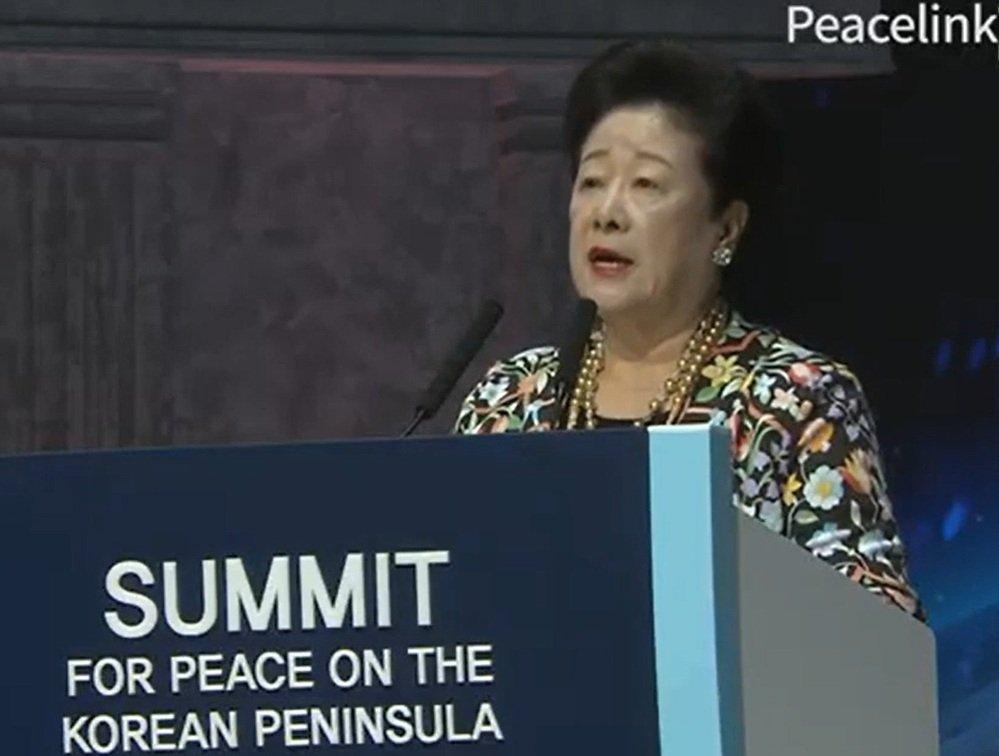 Mother Han, Hak Ja Han, proposing a vision for the Korean peninsula. Screenshot from transmission by Peacelink TV.
At this point, the author introduces a crucial distinction: proposing a vision is not the same as having the authority to implement it. In modern states, only governments control national budgets, diplomacy, and security policy. Religious groups and civil society organizations can advocate ideas, but they cannot turn them into law or infrastructure on their own. This creates an inherent structural tension. Big ideas about peace and reconciliation may originate outside government, but they can only be realized through political decision-making.
According to Moon’s article, this is where things often go wrong. When political systems are unable ‒ or unwilling ‒ to engage seriously with long-term, cross-national challenges, those ideas have no clear institutional pathway. Formal channels such as parliamentary debate, official commissions, or public referenda may move too slowly, be blocked by partisan conflict, or prioritize short-term electoral concerns. As a result, advocates for large, long-range projects sometimes turn to informal influence, private persuasion, or indirect access to decision-makers.
From the outside, such behavior can easily look suspicious. In Western discourse, “backdoor politics” is often equated with corruption or illegitimate lobbying. The article acknowledges that lobbying for narrow private gain should be firmly rejected. However, it also poses an uncomfortable question: what happens when even broadly public-minded visions cannot enter the political system through legitimate, transparent means? In that case, the problem may not lie solely with the actors knocking on the door, but with the political structure that keeps the door closed.
 Part of the peace vision: Korean reunification. Illustration: Microsoft Designer Image Creator, 26th August 2024.
The author argues that debates over church-state separation in Korea have intensified precisely because governments have failed to take responsibility for long-term regional peace strategies. Reconciliation between Korea and Japan, stability in Northeast Asia, and durable peace on the Korean Peninsula are issues that require continuity beyond a single administration. Yet, in practice, few governments have pursued these goals consistently. When the state retreats from this role, non-state actors ‒ religious groups included ‒ step into the vacuum.
From this angle, the Family Federation’s peace initiatives are less evidence of religious overreach than of governmental absence. Regardless of how one judges the movement itself, the article suggests that it was at least willing to sustain long-term visions that the state repeatedly postponed or abandoned. Once those visions began to intersect with real political possibilities, engagement with politicians became unavoidable.
The danger, the author warns, is oversimplification. If all such engagement is dismissed as a violation of secular principles, the core issue ‒ peace and long-term regional cooperation ‒ gets lost. Religion becomes permanently suspect, while politicians avoid accountability by pointing to church-state boundaries rather than making difficult decisions. This leads to a cycle of mistrust and inaction.
The article concludes by returning the responsibility to politics. Projects like the Korea-Japan undersea tunnel should absolutely be debated, criticized, and scrutinized. But before rejecting them outright, society should ask why such ambitious peace proposals so often originate outside the state. Ultimately, the author calls for political leadership capable of translating moral or religious visions into the secular language of public interest, national benefit, and long-term value. True peace, the opinion piece argues, begins when governments are willing to reclaim that role ‒ so that big ideas no longer have to enter politics through the backdoor at all.
See also At Issue: Religions Taking Reality Seriously
See also Devotion of Japanese Wives in Korea Awarded
See also When Special Prosecutors Become Political Tools
See also Religion Between Engagement and Withdrawal
See also Climate of Suspicion: Peace Reframed as Politics
See also Korea: Can Religion and Politics Be Disentangled?
See also Faiths Caught in Expanding Political Crackdown
See also Some Religions Are Welcome in Politics, Some Not
See also Peace Ambassador Program Is Civic, Not Political
See also Shared Prison Experience: Resonance of Two Souls
Text: Knut Holdhus, editor
Featured image above: Illustration of undersea tunnel between South Korea and Japan. Image: Chat GPT, 1st January 2026.
See also Response to “Pilgrimage by Ferry” Media Claims
See also Fact-Based Clarification of Media Misreporting
See also President’s Own Party Drawn into Lobbying Claims
See also Faith, Finance, Fairness: Rethinking the Narrative
See also Balcomb: “Prosecutors’ Case Is Politically Driven”
See also Likely Long Legal Battle Ahead for Mother Han
See also Bail Hearing with Mother Han’s Spiritual Message
See also Trial Day 1: Mother Han Denies All Allegations
See also Asia Today Editorial: “Avoid Detention of Clergy!”
See also Complaint Filed Against Lead Special Prosecutor
See also SKorea’s Polarization Shapes Views of Mother Han
See also Inside the Detention Center: A 10-Minute Visit
See also Health Concerns: 82-Year-Old Pretrial Detainee
See also In Tiny Solitary Cell: Irreversible Harm Caused
See also Mother Han Briefly Released for Medical Reasons
See also Message of Religious Unity from Detention Cell
See also Over 50 Days in Vigil Outside Detention Center
Related to state failure and peace projects: Mother Han’s December Trial: Long Detention Ahead
Also related to state failure and peace projects: A 10-Minute Visit to Mother Han in Detention
Also related to state failure and peace projects: Denying Allegations: Hak Ja Han (82) in Inquiry
Also related to state failure and peace projects: SKorean Court’s Sharp Criticism of Prosecutors
And also related to state failure and peace projects: Detention: Harsh Cell Conditions Spark Outcry
More, related to state failure and peace projects: Ugly: Arrest Warrant Sought for Hak Ja Han (82)
And more, related to state failure and peace projects: Critics Warn of “Authoritarian Drift” in SKorea
Even more, related to state failure and peace projects: Court Decision to Prolong Detention Condemned
Still more, related to state failure and peace projects: Co-Founder, 82, Questioned 9 Hours by Prosecutors
Also related to state failure and peace projects: Democratic Party’s Assault on Family Federation
And even more, related to state failure and peace projects: Mother Han (82) in Poor Health in Damp, Cold Cell
And still more, related to state failure and peace projects: Korean Crisis: “True Democracy Must Serve Heaven”
And yet more, related to state failure and peace projects: Faith Leaders Protest State Assault on Religion
Also related to state failure and peace projects: News Release Blasts Indictment of Hak Ja Han, 82
More, related to state failure and peace projects: 70 Years On: Detention History Repeats Itself
And more, related to state failure and peace projects: Trump Raises Alarm Over Church Raids in Korea
Even more, related to state failure and peace projects: Mike Pompeo Calls Probe of Co-Founder “Lawfare”
Still more, related to state failure and peace projects: Korean Faith Crackdown: USA Urged to Confront It
Yet more, related to state failure and peace projects: Korean Bribery Scandal: Media Clears Federation
And also related to state failure and peace projects: Raids Blur Line Between Justice and Politics
More, related to state failure and peace projects: Heavy-Handed Raid on Sacred Sites Condemned
And more, related to state failure and peace projects: Scholar Sounds Alarm: State Raiding the Sacred
Even more, related to state failure and peace projects: Raids as Political Spectacle and Media Trials
And even more, related to state failure and peace projects: Religious Freedom: 330 Faith Leaders Speak Up
Yet more, related to state failure and peace projects: Yonhap: Repeated Allegations Create Public Bias
Still more, related to state failure and peace projects: Japan Following the Way of China
And still more, related to state failure and peace projects: Warning of Threat from CCP Fearing Korean Unity
And also related to state failure and peace projects: Japan’s Dissolution Case Echoes China’s Playbook


