The latest version of Unification Thought: New Essentials of Unification Thought, published in 2006.
From materialism to Godism: A new series examines the gap between communism’s promise of equality and the realities of political control
A new series examines why an ideology that promised equality and freedom ultimately produced systems of oppression, and explores the search by Lee Sang-heon (이상헌 – also romanized as Sang Hun Lee) for a deeper foundation for human dignity.
Continued in part 2: The Love Materialism Failed to Explain
Continued in part 3: Can Revolution Change Human Nature?
See also A Search for Truth Shaping Unification Thought
See also From “Scattered Pearls” to Systematic Philosophy
See also Why Unification Thought Matters in 2026
Communism was one of the most influential political and philosophical movements of the 20th century. It attracted millions of people with the promise of overcoming exploitation, abolishing class divisions, and creating a society in which everyone could enjoy freedom and material prosperity. For many of its adherents, communism represented not merely a political program but a path toward the liberation of humanity.
Yet the historical outcome often contradicted those aspirations. Communist regimes concentrated power in the hands of the state and ruling parties, restricted individual freedoms, and subjected entire populations to political control. In North Korea, the concentration of authority went so far that the country’s leader came to occupy an almost absolute position, surrounded by an extensive cult of personality.
How could an ideology dedicated to human liberation lead to such outcomes? And what did its philosophical foundations overlook?
 The logo of the Segye Ilbo, one of the top 10 comprehensive daily newspapers in South Korea.
 Religious affairs reporter Jeong Seong-su (정성수). Photo (2025): Segye Ilbo
These questions lie at the heart of Communism Without God: Lee Sang-heon’s Intellectual Journey and the Path to Human Liberation, a series published by the South Korean newspaper Segye Ilbo. In the second installment, published on 15th October 2026, religion correspondent Jeong Seong-su (정성수) explores the relationship between materialism, human nature, and the origins of love.
The series draws on the lectures, writings, academic papers, and testimonies of Lee Sang-heon (1914–1997), a physician and philosopher who developed Unification Thought (통일사상) [See editor’s note 1 below]. Lee had once embraced the communist movement, believing it offered a way to achieve both national independence and human liberation. His subsequent intellectual journey led him to question whether communism’s materialist understanding of humanity could adequately explain the qualities that make human life meaningful.
For Lee, the fundamental problem was not simply that communist governments had made political and economic mistakes. He traced a deeper difficulty to the philosophical denial of God. In his view, God was not merely an object of religious devotion but the ultimate source of human existence, the foundation of love and conscience, and the basis of a human dignity that no government or political party should be permitted to violate.
By reducing human beings to material conditions and class relationships, Lee argued, materialism overlooked an essential dimension of human nature. An ideology might promise to liberate people from external oppression, but if it failed to understand the foundations of conscience, love, and moral responsibility, it could also fail to protect them from new forms of domination.
 8th December 1991: Signing the Agreement to eliminate the USSR and establish the Commonwealth of Independent States. Ukrainian President Leonid Kravchuk (second from left seated), Chairman of the Supreme Council of the Republic of Belarus Stanislav Shushkevich (third from left seated) and Russian President Boris Yeltsin (second from right seated) during the signing ceremony to eliminate the USSR and establish the Commonwealth of Independent States. Viskuly Government House in the Belorusian National Park “Belovezhskaya Forest”. Photo: RIA Novosti archive, image #848095 / U. Ivanov / Wikimedia Commons. License: CC ASA 3.0 Unp. Cropped
The historical collapse of communist regimes in Eastern Europe in 1989 and the dissolution of the Soviet Union in 1991 appeared to mark the end of an era. Nevertheless, communist or communist-derived one-party systems continue to govern countries including China, Vietnam, Laos, North Korea, and Cuba. Meanwhile, economic inequality and social alienation remain serious concerns even in liberal democratic societies.
The challenge, therefore, is not simply to declare communism a failed experiment and move on. Inequality, poverty, and exploitation cannot be dismissed merely because communist solutions have often proved oppressive. At the same time, addressing these problems by treating entire social classes as enemies or granting excessive power to the state risks reproducing the very restrictions on freedom that human liberation was supposed to overcome.
The series seeks to examine this dilemma without limiting itself to a retrospective critique of communism. It considers how the movement emerged, why it appealed to so many people, and how its original promises became associated with coercion and repression. It also introduces Unification Thought (통일사상) [See editor’s note 1 below] as an alternative developed by Lee, emphasizing the relationship between human freedom, dignity, responsibility, and love.
A central concept in this alternative is Godism (하나님주의) [See editor’s note 2 below]: the idea that a sound social order must recognize God as the source of human existence and establish relationships grounded in love and conscience rather than power and self-interest.
From this perspective, genuine liberation requires more than changing political institutions or economic arrangements. It also requires a transformation in how people understand themselves and relate to others. A society cannot secure lasting freedom simply by replacing one ruling group with another if the underlying desires for domination and control remain unchanged.
The series thus raises a question extending beyond communism itself: What philosophical foundation can support a society that protects individual freedom while also confronting inequality and encouraging responsibility toward others?
The intellectual journey of Lee Sang-heon (이상헌 – also Romanized as Sang Hun Lee) offers one proposed answer. By reconsidering the relationship between God, human nature, and social organization, the series invites readers to examine whether the pursuit of a more humane world requires not only institutional reform but also a deeper understanding of the origins of love and human dignity.
Based on the article of Jeong Seong-su (정성수) in Segye Ilbo, 15th October 2026, the second installment of the series “Communism Without God”
Continued in part 2: The Love Materialism Failed to Explain
Continued in part 3: Can Revolution Change Human Nature?
See also A Search for Truth Shaping Unification Thought
See also From “Scattered Pearls” to Systematic Philosophy
See also Why Unification Thought Matters in 2026
Text: Knut Holdhus, editor
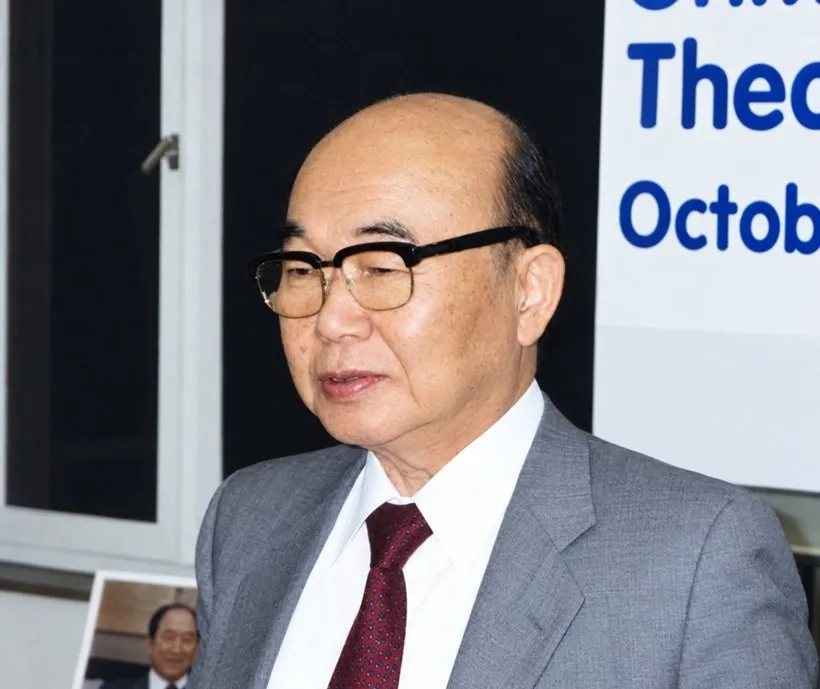
Featured image above: Dr. Lee Sang-heon (이상헌 – also romanized as Sang Hun Lee – 1914–1997), a South Korean physician and philosopher who developed Unification Thought (통일사상) [See editor’s note 1 below], here at a seminar in Schmitten, Hessen, Germany in October 1991. Photo: FFWPU, improved resolution by Grok xAI, October 2026.
[Editor’s note 1: Unification Thought is a philosophical system developed by Sang Hun Lee (1914-1997) from the teachings of Sun Myung Moon (1920-2012). It was designed as a comprehensive worldview that integrates religion, philosophy, science, ethics, and social theory into a single framework centered on God’s purpose for creation.
At its core, Unification Thought argues that reality reflects the nature of God, understood as a being of “dual characteristics”: internal character and external form, as well as masculinity and femininity in harmonious unity. Human beings, according to this view, are created to embody divine love through mature relationships, family life, creativity, and moral responsibility.
The system places strong emphasis on purpose and relationality. Everything exists through “give-and-take action”, a dynamic process of interaction that produces harmony, growth, and development. Human history is interpreted as a providential process aimed at restoring the ideal world originally intended by God, overcoming alienation, conflict, and selfishness caused by the human fall.
Unification Thought also attempts to respond to modern ideologies. It criticizes both materialistic Marxism and purely secular humanism while also seeking to modernize traditional religious thinking. Its ethical and political applications include theories of education, art, economics, and social organization grounded in family-centered ethics and mutual cooperation. The philosophical system can be regarded as a synthesis of Eastern and Western thought, religion and science.]
[Editor’s note 2: “Godism” (하나님주의) is one of the central philosophical and theological ideas associated with Sun Myung Moon (문선명) and the Unification movement. 하나님 (Hananim) = “God” (the personal, loving Creator). 주의 (主義) = “-ism” or “principle/ideology”. So 하나님주의 (Godism) literally means “ideology centered on God”.
Sun Myung Moon presented Godism as a third ideological alternative to capitalism and communism, especially during the Cold War. It was meant to be a moral and spiritual worldview that could reconcile left and right, transcending materialistic and human-centered ideologies.
This is closely connected with his idea of Head-Wing Thought (두익사상) [See editor’s note 3 below] – where Godism serves as the core spiritual content, and Head-Wing Thought serves as the social-political application.
The core principles of Godism:
- God-centered humanism – Humanity’s ultimate purpose is not self-centered fulfillment but living for the sake of others, reflecting God’s heart of love.
- Dual purpose of life – Each individual exists both for personal perfection (becoming one with God in love) and for the good of others (family, society, and the world).
- Family as the school of love – True love begins in the family and expands to all levels of human relationships, reflecting God’s parental heart.
- Unity of science and religion – Godism seeks to harmonize spiritual truth and scientific understanding under a divine purpose.
- Overcoming ideological conflict – By centering politics and economics on God’s love, Godism proposes peace through moral renewal, not domination or class struggle.]
[Editor’s note 3: Head-wing thought (두익사상 – 頭翼思想) is a concept coined by Sun Myung Moon. 두 (頭) = “head”, 익 (翼) = “wing”, 사상 (思想) = “thought” or “ideology”. So 두익사상 literally means “Head-Wing Thought.”
It was developed by Sun Myung Moon (Co-Founder of the Family Federation) and his followers as a philosophical framework intended to transcend and harmonize left-wing (liberal/socialist) and right-wing (conservative/capitalist) ideologies – hence the “head” guiding both “wings”.]
Related to promise of equality: At Issue: Religions Taking Reality Seriously
Also related to promise of equality: Religion Between Engagement and Withdrawal
Also related to promise of equality: State Failure and Non-State Peace Projects
And also related to promise of equality: Unificationism Emerging as a World Religion
More, related to promise of equality: Decline of Family Values Creates Social Crisis
Also related to promise of equality: Essence of God
More, related to promise of equality: God and Human Beings
Also related to promise of equality: The Kingdom of Heaven
And also related to promise of equality: True Love
More, related to promise of equality: The Value of the Family
And more, related to promise of equality: God’s ideal
Still more, related to promise of equality: God’s Sorrow
Yet more, related to promise of equality: Suffering of God
And yet more, related to promise of equality: Family values
Also related to promise of equality: Meaningful Marriage
More, related to promise of equality: Living for Others
More, related to promise of equality: Family as School of Love
More, related to promise of equality: Parents and Children
More, related to promise of equality: Teachings Make Great Strides in New Version
And more, related to promise of equality: In a Nutshell
Yet more, related to promise of equality: Brief about the Teachings
Still more, related to promise of equality: Relationships
Even more, related to promise of equality: Gender-Balanced Understanding of God and Christ
And yet more, related to promise of equality: God as Our Heavenly Parent (Father and Mother)
And still more, related to promise of equality: History of God: From Yahweh to Father to Parent
And even more, related to promise of equality: Religious Truth as Progressive Revelation
Also related to promise of equality: Essential Motherly Part of Messianic Mission
Also related to promise of equality: The 3 Blessings and the Process to Fulfil Them
Also related to promise of equality: Unification Principles